Primary School Education7 min read
Year 4 Multiplication Tables Check: The 6-Second Digital Speed Blueprint for Primary Maths
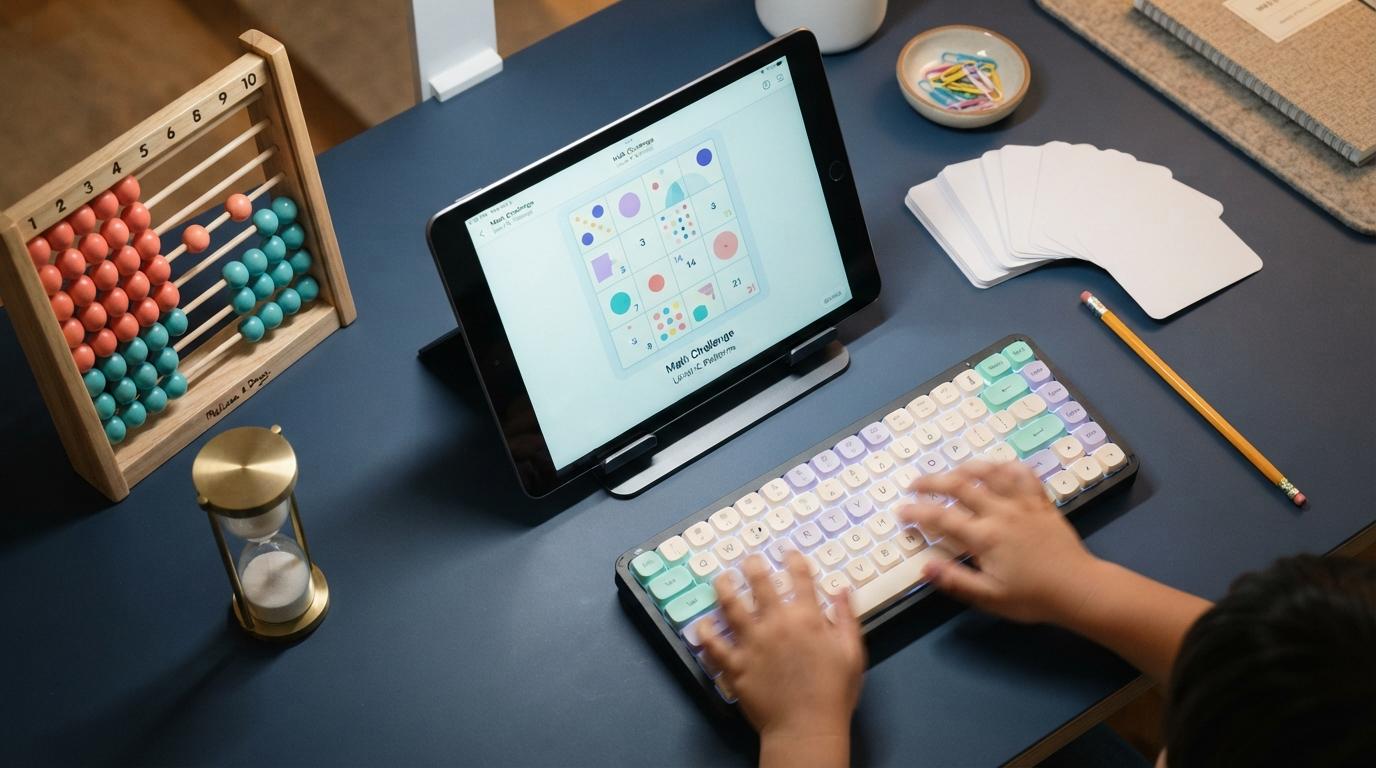
Decoding the Year 4 Multiplication Tables Check: Digital Mechanics and Time Pressures
If your child is sitting the statutory UK Year 4 Multiplication Tables Check (MTC)—whether in an international school curriculum here in Singapore or as part of a rigorous home benchmarking routine—the format can come as a sharp shock. The official assessment consists of 25 randomised digital questions delivered on a computer or tablet. Pupils face an uncompromising 6-second timer per question, separated by a brief 3-second pause before the next equation immediately loads. While there is no official passing mark mandated by the Standards and Testing Agency (STA), achieving a perfect score of 25/25 is widely regarded as the expected standard for mathematical fluency.
For primary school parents accustomed to standard pen-and-paper worksheets, the digital nature of the test introduces an unexpected cognitive bottleneck. A child who can comfortably write down times tables on a static grid often freezes when confronting an animated visual timer counting down from six seconds. Solving this hurdle requires understanding not just basic multiplication facts, but the cognitive mechanics of rapid digital retrieval, physical input ergonomics, and the specific question weighting built into the test engine.
The Anatomy of the 6-Second Rule
To prepare effectively, parents must deconstruct what actually happens during those six seconds. Six seconds sounds generous for single-digit multiplication like \(4 \times 5\), but it vanishes rapidly during boundary items like \(8 \times 7\) or \(12 \times 9\). Cognitive research into young learners breaks the 6-second digital response window into three distinct phases:
1. Question Decoding and Visual Orientation (1.0 to 1.5 seconds): The child registers the digits on screen, identifies the multiplication operator, and filters out the movement of the ticking countdown bar.
2. Fact Retrieval and Working Memory (1.5 to 2.0 seconds): The pupil retrieves the semantic memory of the product. If the child relies on rhythmic skip-counting (e.g., chanting \(7, 14, 21, 28, 35\dots\)) rather than direct visual or auditory recall, this phase alone consumes 4 to 5 seconds, leaving zero margin for digital entry.
3. Numeric Entry and Confirmation (2.0 to 2.5 seconds): The child locates the correct keys on an on-screen touch pad or physical keyboard number row, taps the two-digit answer, and presses enter or allows the timer to log the value.
When a child lacks automated recall, motor hesitation combines with panic. By training with deliberate pacing protocols on the Thinka AI-powered practice platform, learners develop immediate reflex recall, shrinking the retrieval window down to under 0.8 seconds and eliminating test-induced cognitive freeze.
The High-Frequency Weighting Matrix: Why 6, 7, 8, 9, and 12 Dominate
A common mistake among parents is spending equal revision time across all times tables from 2 to 12. The official STA assessment framework does not distribute questions evenly. Instead, the test algorithm is explicitly weighted toward the most challenging, high-friction multiplication tables.
The test engine restricts simpler tables like the 2s, 5s, and 10s to a strict minimum, frequently generating no more than a few baseline questions across the entire 25-item run. Conversely, the algorithm draws disproportionately from the boundary cluster: the 6, 7, 8, 9, and 12 times tables. In particular, the following high-collision equations appear with significant statistical frequency:
High-Stakes Retrieval Targets:
\(6 \times 7 = 42\) and \(7 \times 6 = 42\)
\(6 \times 8 = 48\) and \(8 \times 6 = 48\)
\(6 \times 9 = 54\) and \(9 \times 6 = 54\)
\(6 \times 12 = 72\) and \(12 \times 6 = 72\)
\(7 \times 8 = 56\) and \(8 \times 7 = 56\)
\(7 \times 9 = 63\) and \(9 \times 7 = 63\)
\(7 \times 12 = 84\) and \(12 \times 7 = 84\)
\(8 \times 9 = 72\) and \(9 \times 8 = 72\)
\(8 \times 12 = 96\) and \(12 \times 8 = 96\)
\(9 \times 12 = 108\) and \(12 \times 9 = 108\)
\(12 \times 12 = 144\)
Targeting these specific pairs through high-density drilling ensures your child secures marks on the exact questions designed to separate median scorers from pupils achieving 25/25.
Bridging Global Multiplication Benchmarks with Local Primary Mathematics
Singapore primary mathematics places immense emphasis on mental arithmetic early in the curriculum. Multiplication tables for 2, 3, 4, 5, and 10 are introduced in Primary 2, while the remaining tables (6, 7, 8, and 9) are formally consolidated in Primary 3. By Primary 4, pupils are expected to apply these facts effortlessly to multi-digit multiplication algorithms, fractions, and ratio concepts.
While local MOE schools assess computation through written formats rather than a stand-alone 6-second digital screen test, the underlying cognitive requirement is identical. In upper primary assessments and ultimately the PSLE Mathematics Paper 1 (which strictly forbids the use of calculators), pupils face severe time limits across Booklet A multiple-choice questions and Booklet B short-answer problems. A student who must manually calculate \(7 \times 8\) wastes precious seconds and depletes finite working memory that should be reserved for unpacking complex multi-step heuristic problems.
Treating the Year 4 digital multiplication benchmark as a universal speed diagnostic builds the mental resilience needed for competitive non-calculator papers down the road. Parents looking for structured topical worksheets and revision templates can explore our curated primary mathematics study materials to reinforce foundational numeracy alongside digital speed drills.
Digital Ergonomics: Hardware Differences That Impact Marks
One overlooked factor that derails well-prepared pupils during the Year 4 check is device unfamiliarity. The test is administered across various hardware configurations, and the physical interface alters motor input speeds:
1. Touchscreen On-Screen Keypads: When administered on an iPad or tablet, pupils must navigate a virtual numeric pad. If the interface layout differs from the calculator app they use at home (e.g., telephone layout with 1-2-3 at the top versus traditional calculator layout with 7-8-9 at the top), input errors spike.
2. Physical Keyboard Number Rows: On a standard laptop, children frequently hunt-and-peck across the horizontal top number row (1 through 0). Striking \(5\) and \(6\) horizontally takes significantly longer than using a dedicated 10-key numeric keypad.
3. Accidental Double-Strikes and Backspace Hesitation: If a child types an accidental extra digit, correcting it via the backspace key within a 6-second limit almost guarantees a timeout. Pupils must be trained to stay calm, recognise whether an input error can be salvaged in under two seconds, or immediately reset their attention for the upcoming question during the 3-second transition window.
Why Traditional 12x12 Grids Fail (And How Adaptive AI Fixes Recall)
For decades, standard revision involved handing children a blank 12x12 grid to fill out sequentially. While this reinforces conceptual understanding of arrays and commutativity (that \(a \times b = b \times a\)), it completely fails to cultivate rapid, out-of-sequence retrieval.
Sequential tables encourage linear counting chains. A child asked to solve \(8 \times 7\) silently recites: \(8, 16, 24, 32, 40, 48, 56\). Under a 6-second countdown, this linear dependency breaks down. What pupils need is direct lexical access—the mathematical equivalent of instant word sight-reading.
Modern digital learning transforms this process. Through intelligent algorithms on the Thinka AI-powered revision engine, practice shifts dynamically based on real-time latency. If a child answers \(3 \times 4\) in 1.1 seconds but hesitates on \(7 \times 8\) for 4.2 seconds, the system flags the retrieval latency. Instead of serving random questions, the platform applies spaced repetition protocols, interleaving \(7 \times 8\), \(8 \times 7\), and related division facts (\(56 \div 8\)) until the neural pathway is hardwired into reflex memory.
Furthermore, classroom educators can utilise Thinka's automated assignment and test generation tools to build customized, timed arithmetic drills tailored directly to their students' specific speed bottlenecks.
The 4-Week Rapid Recall Action Plan
If your child is weeks away from the official assessment window, implement this progressive 4-week structured schedule to replace panic with precision:
Week 1: Boundary Diagnostic and Untimed Mastery
Isolate the high-collision tables: 6, 7, 8, 9, and 12. Run oral flashcards without any timer. Focus on absolute accuracy and verbal immediacy. Ensure the child instantly recognises commutative equivalents so they only have to master half the grid.
Week 2: Digital Transition and Keyboard Dexterity
Transition from oral practice to the exact hardware device your child will use during the test. Practise single-hand positioning over the physical number row or virtual numeric keypad. Introduce generous 10-second timers to build digital comfort without triggering adrenaline spikes.
Week 3: The 6-Second Benchmark Run
Drop the timer to the official 6-second threshold with 3-second rest periods. Run daily 25-question simulation blocks. Audit the results immediately: did the errors stem from calculation mistakes, or did the clock simply expire before physical input? Focus exclusively on eliminating timeouts.
Week 4: Pressure Inoculation and Recovery Tactics
Simulate full test conditions with ambient classroom noise or minor distractions. Teach the critical emotional regulation rule: if a question times out, it is gone. Taking cognitive residue from a missed question into the next screen will cost multiple marks. A 3-second deep breath between items resets focus for a flawless finish.
Related posts
- Nov 1, 2026
PSLE AL Score Conversion Guide: Raw Mark Bands, Posting Groups, and Bridging the 4-Mark Leap
Demystify Singapore PSLE Achievement Levels (AL1–AL8). Discover raw mark conversion bands, Full SBB Posting Groups, and AI diagnostic tactics to jump grade tiers.
- Oct 21, 2026
ISEE vs SSAT for Primary School Admissions: Scoring, Format, and Parent Guide
Choosing between ISEE vs SSAT for private or international school entry? Compare scoring, guessing penalties, test formats, and child cognitive fit.
- Oct 11, 2026
Year 4 Times Tables Test Pass Mark: The 6-Second MTC Format and 25/25 Fluency Guide
Wondering about the Year 4 times tables test pass mark? Discover why 25/25 is the true benchmark, the 6-second MTC screen rule, tricky table pairs, and speed drills.
- Oct 1, 2026
PSLE Raw Mark to AL Conversion Guide: Achievement Level Thresholds, Posting Groups, and Mark Optimisation
Demystify Singapore PSLE raw mark to Achievement Level (AL) conversion. Discover AL1-AL8 score boundaries, Posting Groups 1-3 cut-offs, and borderline score tactics.